
📖 Easy Read

The BECK Assessment

  • It helps us understand what you know, and what you want to learn, about your body and relationships.
  • We use pictures, cards, and simple scales. There is no long list of questions.
  • You can answer with pictures, signs, gestures, or a device. Every way of talking counts.
  • We go at your pace. You are always in charge.

HomeThe BECK Assessment

The signature offering

The BECK Assessment

A structured sexual health assessment tool designed specifically for non-verbal persons with Autism. It supports communication, understanding, and safe decision-making through accessible and adaptable methods.

Made for you, not a form

  • Old assessments use lots of talking and reading. That leaves many people out.
  • The BECK Assessment uses pictures, cards, and AAC instead.
  • It shows what you understand, what you want to learn, and how to stay safe, on your terms.

What it is

An assessment built around the person, not the questionnaire.

Traditional sexual health assessment relies on verbal questioning and abstract reasoning, which is inaccessible by design for many non-verbal people. The BECK Assessment replaces that with structured, accessible methods that meet each person in their own communication style.

It draws on visual supports, picture cards, visual scales, inputs, and gestures, so a person can show their needs, preferences, and safely, at their own pace.

The result

A clear picture of what someone understands, what they want to learn, and how to keep them safe, on their terms, never forced into a format built for someone else.
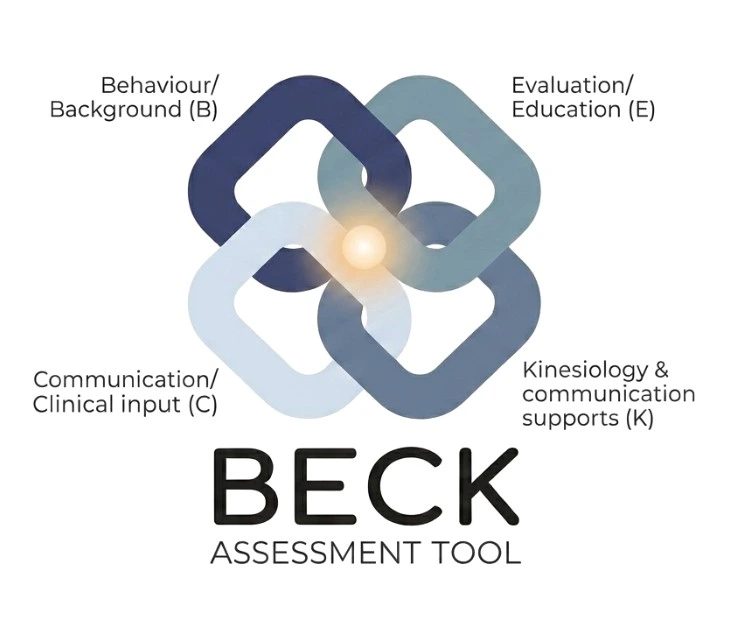
The BECK Assessment Tool diagram: four interlocking rounded petals meeting at a central point, labelled Behaviour/Background (B), Evaluation/Education (E), Communication/Clinical input (C), and Kinesiology & communication supports (K).

The four parts of BECK

  • B – Behaviour and Background: we get to know you and your life.
  • E – Evaluation and Education: we see what you know and teach with care.
  • C – Communication and Clinical: we use accessible communication and work with your team.
  • K – Kinesiology and supports: body, movement, and AAC tools help you.

The BECK framework

Four pillars, one person at the centre.

Each letter represents a dimension of the assessment. Together they build a holistic, dignity-first understanding of the individual.

Behaviour / Background

Understanding the person and their context: history, environment, and the behaviours that may be communicating an unmet need.

Evaluation / Education

Assessing current knowledge and identifying what to teach, with affirmative, repetition-friendly education.

Communication / Clinical input

Accessible communication paired with clinical collaboration, so the right supports and referrals are in place.

Kinesiology & communication supports

Body, movement, and AAC supports that help a person express and understand safely.

How we communicate

  • Visual supports: picture cards, choice boards, and social stories.
  • AAC: devices, symbols, and gestures count as your voice.
  • Visual scales: picture scales for comfort, consent, and what you like.

How we communicate

Accessible methods, adapted to each person.

Visual supports

Picture cards, choice boards, and social stories that make abstract ideas concrete and choosable.

AAC inputs

Augmentative & alternative communication (devices, symbols, and gestures) honoured as valid voice.

Visual scales

Calibrated, picture-based scales for comfort, consent, and preference, clear without words.

Built on trusted practice

  • Person-centred and trauma-informed care: your dignity and safety come first.
  • Visual supports like PECS, choice boards, and social stories.
  • AAC for communication.
  • Trusted tools and programs, like the SexKunn tool and Our Whole Lives.

Grounded in evidence

Built on established, accessible practice.

The BECK Assessment is anchored in recognized, evidence-based models for accessible communication and affirmative sexual health education.

  • & care: autonomy, dignity, and safety first.
  • Visual supports: , choice boards, and .
  • AAC: augmentative & alternative communication.
  • The SexKunn tool (Svae et al., 2024).
  • Our Whole Lives curriculum: repetition and affirmative education.
Cupped hands holding a glowing illustration of many connected people icons linked by arrows, representing a supportive communication network.

What to expect

  • First, we get to know you and the people who help you.
  • Then we do the assessment with pictures and easy methods.
  • Last, we make a plan, plus tips for carers, so help continues every day.

What to expect

A calm, structured process.

  1. Step 01

    Person-centred intake

    We learn about the individual, their context, and the people who support them, with no assumptions.

  2. Step 02

    Accessible assessment

    Using the BECK framework and accessible methods, we build a clear, respectful picture together.

  3. Step 03

    Individualized plan

    A practical sexuality plan plus guidance for caregivers, so support continues every day.

Sexual health is a human right

  • Sexual health is a human right. It is not a privilege.

“Sexual health is a human right, not a privilege.